The specification of Versace furniture in a high-asset-value UAE property is an important decision, balancing aesthetic appeal with a technical calculation of material degradation rates against projected ROI over a 15-year cycle. While the iconic branding serves as a powerful amplifier, the underlying material science is what dictates whether an asset depreciates quickly or holds its value for over a decade. The visual identity is the initial appeal; the engineering determines the long-term investment performance.
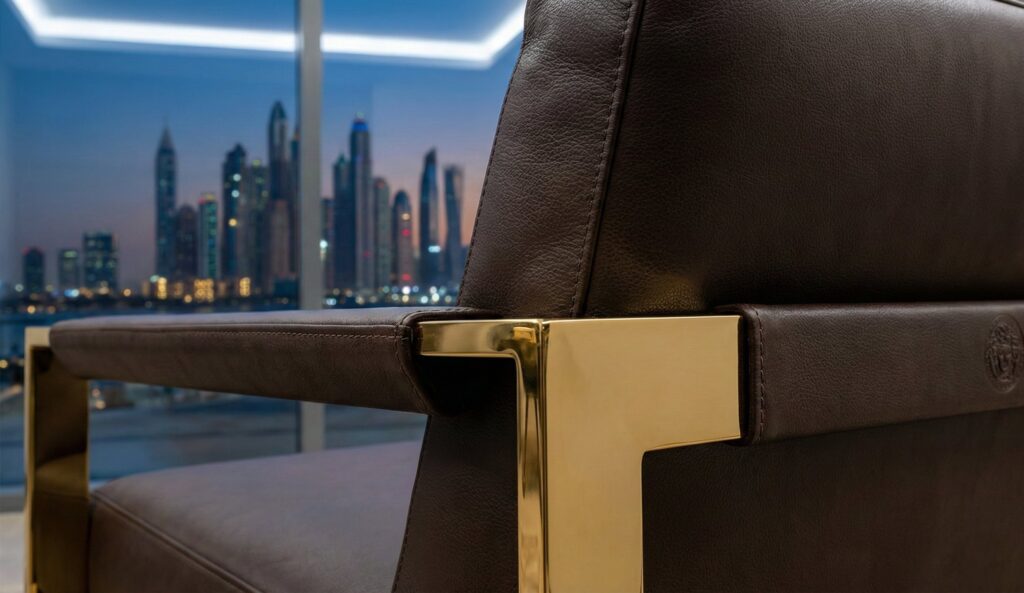
Material Science in Demanding Environments
The ambient environment in the UAE presents unique challenges for interior assets. High external humidity creates a significant vapor pressure differential with climate-controlled interiors, placing a constant hygroscopic load on wood-based composites. Standard materials like MDF may exhibit expansion and delamination within a few years if their moisture content equilibrium point is not compatible with the HVAC design parameters. This principle extends to all components. For example, metallic finishes require precise application, such as physical vapor deposition (PVD), to resist corrosion from saline coastal air. Each piece functions as a complex multi-material system that must be specified to perform reliably in a demanding environment, adhering to stringent codes like BS 5852 Crib 5 for fire safety and local green building regulations concerning VOC off-gassing.
Engineering Verification Beyond the Spec Sheet
Supplier specification sheets provide a baseline, but independent auditing against empirical metrics is crucial for guaranteeing asset performance. For instance, instead of accepting a generic ‘high-quality leather’ description, specifications should demand full-grain aniline hides with validated Taber abrasion test results. Similarly, foam density should be defined by its Indentation Force Deflection (IFD) rating and compression set percentage to ensure long-term structural support. The brand promise is upheld when the physical performance of the asset matches its design intent. The following table outlines key engineering minimums compared to common industry specifications.
| Technical Metric | Standard Industry Assumption | Engineering Standard |
|---|---|---|
| Wood Composite Formaldehyde Emission Rate | E1 Class Compliant (<0.1 ppm) | CARB Phase 2 / NAF (<0.05 ppm) |
| Upholstery Fabric Abrasion Resistance | 25,000 Martindale Cycles (General Contract) | 100,000+ Martindale Cycles (Severe Contract) |
| Timber Substrate Equilibrium Moisture Content (%MC) | 8-12% (European Standard) | 6-8% (Acclimatized for UAE HVAC) |
| Casegood Joint Assembly Shear Strength | ~5-7 MPa | >12 MPa (Dowel/Mortise & Tenon) |
| Metallic Finish Salt Spray Test (ASTM B117) | 96 hours | >400 hours |
| Polyurethane Foam Compressive Strength (40% ILD) | 30-40 lbs | >55 lbs with <5% compression set |
| Acoustic Damping Coefficient of Textiles (NRC) | Not Specified | >0.45 NRC for specified surfaces |

Executive FAQ
How do you quantify the delta in brand equity between a visually identical piece of furniture and one engineered to higher standards, and how does this translate to RevPAR over a five-year horizon?
Quantification is achieved through a Total Cost of Ownership (TCO) model, which balances the initial CAPEX premium against projected reductions in operational expenses for repairs and replacements. The brand equity component is valued by modeling the risk avoidance of negative guest experiences, which data suggests can correlate to a measurable premium on RevPAR in the ultra-luxury hospitality segment.
Your specifications exceed minimums. Model the financial break-even point where the initial CAPEX premium is offset by reduced maintenance, refurbishment cycles, and quantifiable risk mitigation against asset failure.
The financial break-even point for specifying higher-grade materials typically occurs between 36 and 48 months. This model is based on a modest CAPEX premium offset by a significant reduction in FF&E maintenance calls, the elimination of at least one refurbishment cycle within a 10-year period, and the mitigation of risks associated with asset failure.
Beyond material science, how does the logistical and installation methodology account for accelerated construction timelines, such as those governed by FIDIC contracts, specifically regarding on-site material acclimatization?
The methodology includes a mandated 21-day acclimatization period for all wood-based components. This process occurs in a dedicated, off-site, climate-controlled facility that replicates the hotel’s final operational environment. By ensuring materials reach their Equilibrium Moisture Content (EMC) before assembly, the risk of post-installation warping and joint stress is effectively eliminated. This step is a critical process gate that de-risks the FF&E lifecycle.